



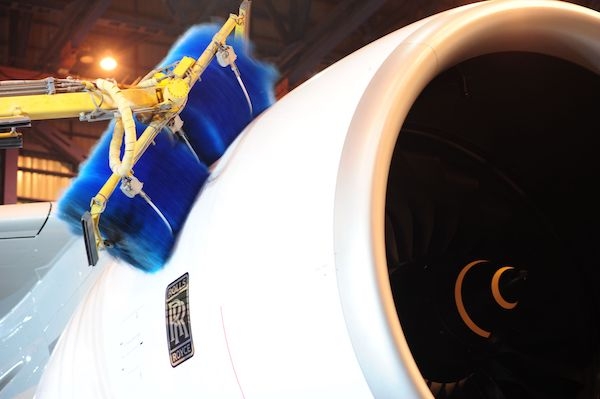
With only 5% of the total aircraft exterior cleaning market represented, the semi-automated robots are a very niche area in the aviation industry. Despite that, it still remains a leader in innovative solutions for exterior washing that a number of airlines and maintenance, repair, and overhaul (MRO) services still have not implemented.
Regarded as a very narrow market, with only two manufacturing companies, semi-automatic aircraft exterior cleaning robots are, surprisingly, not new in the aviation industry. Jan Brunstedt, CEO of Aviator Robotics AB and the creator of Nordic Dino, the leading aircraft exterior cleaning robot, notes that cleaning robots have been around for some 40 years, despite the fact that aviation is currently undergoing rapid automation processes.
“The idea of a semi-automatic aircraft exterior cleaning robot came from a very real pain point that airlines and MROs have been dealing with up to this day. What we call the ‘traditional’ way of washing an aircraft exterior, the wet washing, has presented several problems – primarily, the time spent washing, the manpower needed for it, and the various equipment necessary to complete the job. Having been a commercial pilot for years, I was able to get up close to those issues and understood where the changes could be made. That is how the idea of a semi-automatic exterior cleaning robot came.”
Over the years, the key issues with the traditional way of washing aircraft exteriors have partially been addressed with dry washing – a way of quick washing the body of an aircraft that requires no water but still uses manpower, equipment, and litres of chemicals to do the job. However, according to Brunstedt, very few airlines, and MROs actually use dry washing and usually stick to the traditional way. The reason for it is that current-day Boeings and Airbuses are made of composite materials like fiberglass, which, looking from a cleaning perspective, is more prone to cracks, scratches, and other types of surface damage.
“Around 30-40 years ago, aircraft would be washed only 2 times per year as part of maintenance procedures,” explains Brunstedt. “Nowadays, it has gone up to at least 4 times as the material of the aircraft body has changed and the looks of an aircraft from outside play a bigger part, too.”
Yet, the niche market of semi-automatic cleaning robots seems to hold current-day solutions for both wet and dry washing drawbacks that many airlines and MROs have to deal with. Bunstedt explains that semi-automatic robots ensure the quality and quickness of a full wash, cutting out bulky equipment like lifts, that can also damage aircraft body during a manual wash. Human errors come into play as well, which the robots cut out completely. Together with that, the number of people needed to complete the washing is reduced significantly as well, needing only one or two people at most.
“Some of the largest savings that come with a robotic washing system pay off in 3 to 5 years,” notes Brunstedt. “While it is an investment, it ticks off the main boxes for airlines and MROs when it comes to aircraft exterior cleaning efficiency.”
Avolon, one of the world’s leading aviation finance companies, has reinforced its long-term growth strategy with a firm order for 110 Airbus aircraft, including 35 A330-900 widebodies and 75 A32...
FlyJets, the charter aviation marketplace and flight-sharing exchange, has officially launched JetGPT™, its AI-powered automated flight-finding agent, coinciding with a growing portfolio of flig...
Skandia’s King Air 200/300 soundproofing kit has received final approval from Brazil’s ANAC, opening the door for wider adoption among operators across the country. The certifica...
Rotortrade, the global helicopter dealership, has confirmed its participation in EUROPEAN ROTORS 2026, which will take place at EUREXPO Lyon, France. Marking its first edition in France, EUROPEAN...

