



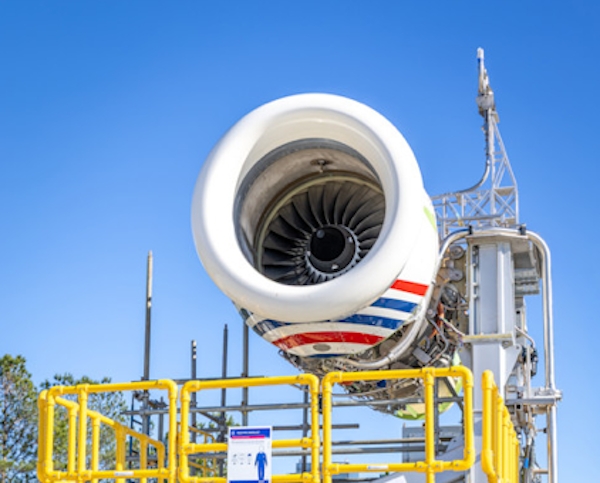
easyJet and Rolls-Royce have announced the successful completion of a major testing milestone using hydrogen as an aviation fuel, marking a significant step in efforts to reduce aviation emissions. In an industry first, the companies tested a modified Rolls-Royce Pearl 15 aircraft engine reaching full take off power while running on 100% hydrogen, at NASA’s Stennis Space Center, near Bay St. Louis Mississippi.
The significant milestone is the result of a four-year programme between Rolls-Royce, easyJet and global partners to explore hydrogen as a potential aviation fuel and generate engineering insight for future propulsion applications. easyJet has played a central role in supporting the development of hydrogen gas turbine technology as part of its long-term decarbonisation ambitions. Rolls-Royce’s expanded partnership with TCS helped accelerate progress towards its technology goals by adding capability and capacity across critical engineering workstreams.
During this phase of the testing programme, engineers demonstrated that a modern jet engine, scalable to power a narrowbody aircraft, can safely operate on gaseous hydrogen across a fully simulated flight cycle, including start-up, take-off, cruise and landing.
The Rolls-Royce programme followed an incremental, technology-led approach to prove the fundamental technologies. Progressing from early engine testing at Boscombe Down in the UK in 2022, the technology was scaled and further developed through a UK and European programme of component and system rig tests, including the development of a full-scale hydrogen test facility at the HSE, before moving to full integration into a hydrogen fuelled demonstrator engine. Earlier modifications also focused on adapting the engine to replace traditional jet fuel with hydrogen while considering both carbon and non-CO2 impacts through an expansive combustion programme.
The programme has delivered valuable insights into hydrogen combustion, fuel systems and engine integration, supporting the potential for future hydrogen-powered aircraft to help significantly reduce carbon emissions across European and UK aviation while complementing Sustainable Aviation Fuel to support future growth - as reinforced by research published in the report Enabling Hydrogen in the European Aviation Market.
David Morgan, Chief Operating Officer at easyJet, commented: “This industry-first is a real testament to the progress our partnership with Rolls-Royce has achieved, taking hydrogen from early concept through to full engine build and successful testing in just a few years. Demonstrating 100% hydrogen operation at scale is a significant milestone and marks an important step towards easyJet’s net zero ambition, supporting the long-term transition to more sustainable aviation.”
Adam Newman, Chief Engineer, Hydrogen Demonstrator Programme, Rolls-Royce, stated: “This programme has given us the clearest understanding in the industry of how hydrogen behaves in a modern aero gas turbine. Through a collaborative, staged testing approach, we have validated combustion, fuel and control system technologies, and demonstrated the safe use of hydrogen through design, commissioning, maintenance and testing. We have explored a wide range of operating conditions, including fault scenarios, enabling operation at maximum power and across a full flight cycle. The pace of delivery has been critical, and the insights gained, many of which are fuel agnostic, will now be applied across our future programmes, including UltraFan, strengthening our confidence that the gas turbine will remain at the forefront of sustainable aviation’s future.”

Anupam Singhal, President – Manufacturing, Tata Consultancy Services said: "This milestone reflects what becomes possible when advanced engineering is combined with digital capabilities and deep ecosystem collaboration to move breakthrough innovation closer to real-world. At TCS, we are proud to support Rolls-Royce in accelerating hydrogen propulsion through integrated engineering, systems, and software expertise.This achievement marks a significant step forward—demonstrating not just the viability of hydrogen, but the industry’s readiness to translate ambition into execution."
Dr Nigel Moss, Aerospace Sector Manager at the Health and Safety Executive’s Science and Research Centre in the UK, added:"Over two decades our science and research centre of excellence has developed world-leading expertise in the safe handling of hydrogen, and our work on this project involved building and testing the pressurised hydrogen infrastructure to meet challenging safety and performance requirements. As always with the aerospace sector, safety was front-and-centre during this ground-breaking work.”
Christine Powell, NASA Stennis Acting Centre Director, said: “NASA Stennis has proven to be a go-to location that enables industry to execute specialized testing that their mission requires. This milestone is a great example of how our infrastructure and expertise can be leveraged to advance future technologies and solve broader challenges.”
Gulfstream Aerospace has enhanced the capabilities of its Customer Support Performance Analytics program, further strengthening its ability to transform aircraft data into actionable insight...
Few infrastructure projects have the potential to reshape an island's future quite like the ongoing transformation of Nevis Airport. To gain deeper insight into this ambitious development and the...
The Tennessee Valley Authority is demonstrating the real-world value of the Tecnam P2012 Special Mission Platform (SMP), which has become a vital tool for monitoring and maintaining its...
Airbus 2026 Cargo Global Market Forecast, unveiled at the Cargo Facts Symposium, predicts that the global fleet of dedicated freighter aircraft will expand by 46%, rising from 2,360 aircraft in 2026 t...

