



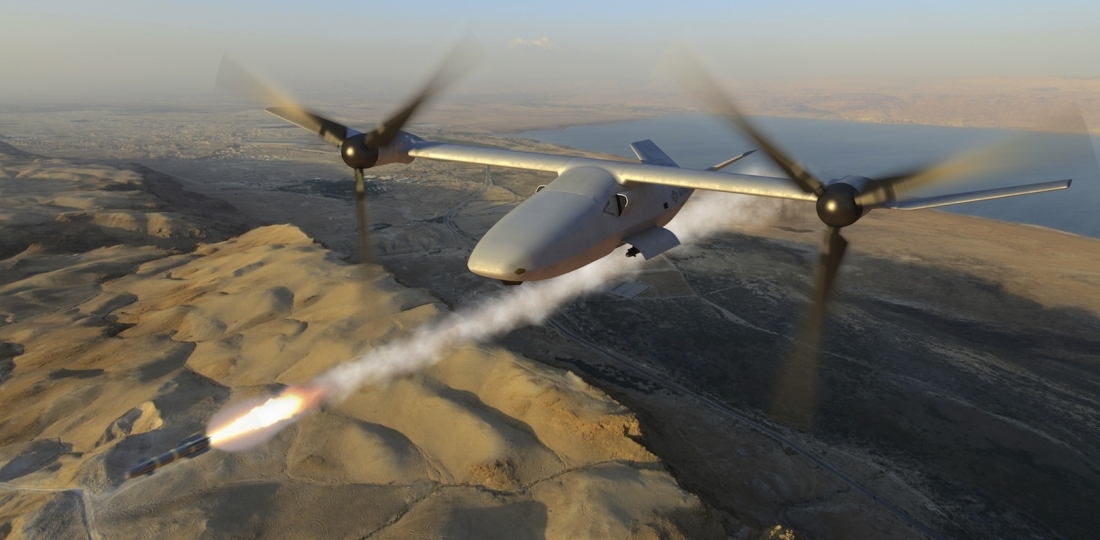
Bell Helicopter unveiled a new unmanned tiltrotor aircraft—the V-247 Vigilant—it is proposing for the U.S. Marine Corps. The manufacturer displayed a one-eighth-scale model of the aircraft with a working swiveling wing at a briefing September 22 in Washington, D.C.
Bell has designed the Vigilant to meet a need expressed in the 2016 Marine Aviation Plan for a large, “sea-baseable” unmanned aircraft system (UAS) capable of performing multiple missions. It would be a Group 5 UAS—weighing 16,000 pounds empty, with the ability to carry 13,000 pounds in fuel, weapons such as the MK-50 torpedo, Hellfire or JAGM missiles, and sensors including sonobuoys and LiDAR or radar modules. Advertised mission range is 450 nm, with time on station of 11 hours.
The vertical takeoff and landing machine builds on Bell’s development of the V-280 manned tiltrotor for the U.S. Army’s joint multi-role demonstration program. There is “significant leveraging of V-280 technology” in the Vigilant, said Vince Tobin, Bell vice president for advanced tiltrotor systems. The design also benefits from Bell’s work on tiltrotors dating to the XV-3 in the 1950s, a legacy that includes the unmanned Eagle Eye developed—but never purchased—for a U.S. Navy requirement in the 1990s and the V-22 Osprey used by the Marine Corps, the Air Force Special Operations Command and eventually by the Navy as the CMV-22B.
Sized to be compatible with the Navy’s DDG-class guided-missile destroyers, the single-engine Vigilant has a V-shaped empennage and fixed center wing that swivels from an in-line position to perpendicular of the fuselage. Outboard prop-rotors and wingtips rotate up for vertical flight and down for horizontal flight. The aircraft’s wingspan is 65 feet; its rotors fold out to a diameter of 30 feet. The wingtips fold back over the center wing, which swivels back over the fuselage for stowage.
The Vigilant promises “expeditionary capability with increased operational flexibility and a reduced logistical footprint,” said Tobin. “The real advantage of this is it colocates with the maneuver force and it isn’t reliant on a runway.”
Bell expects the Marine Corps will establish a formal requirement for the ship-based UAS capability soon, leading to the selection of a contractor to begin engineering and manufacturing development. Bell contends it can start building Vigilants by 2023. “The question that we’re asked is how fast can you go? We interpret that [as being] a near-term need,” Tobin said.
Airbus 2026 Cargo Global Market Forecast, unveiled at the Cargo Facts Symposium, predicts that the global fleet of dedicated freighter aircraft will expand by 46%, rising from 2,360 aircraft in 2026 t...
Textron Aviation has marked a key milestone in the development of the Cessna Citation CJ4 Gen3 with the rollout of the program’s first production aircraft. The achievement brings the next-g...
The Tennessee Valley Authority is demonstrating the real-world value of the Tecnam P2012 Special Mission Platform (SMP), which has become a vital tool for monitoring and maintaining its...
Asco, a subsidiary of Montana Aerospace AG, achieves significant technological milestone in the development of a hybrid multi-material Rear Secondary Structure for Airbus. Montana Aerospace,...

