



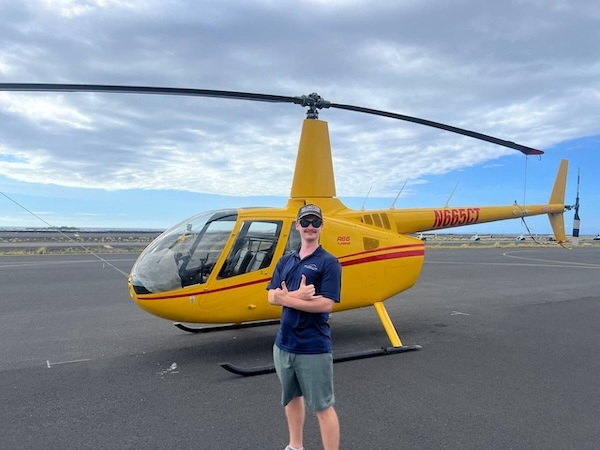
FAA-certified instrument flight instructor with mountain flying experience explains why the shortage will be won or lost in training, not in hiring. The United States pilot shortage reaches its steepest point this year. According to Oliver Wyman's supply and demand analysis, North American airlines will be short about 24,000 pilots in 2026, the worst figure of the current cycle, and the deficit is expected to stay above 17,000 through 2032. The count covers airline cockpits, but the drain starts much earlier, in flight schools. The standard road to an airline seat runs through years of work as a flight instructor, so when carriers hire aggressively, the instructor bench empties first, and helicopter schools, built on the same training model, feel it as sharply as airplane ones.
Scarce instructors are only half of the problem, because enrolling in a school is not the same as earning a certificate. Between the first lesson and a license stands the checkride, a practical exam with an FAA examiner. A failed attempt can mean weeks of additional training, extra expense and, for some students, the end of their aviation ambitions. When training resources are limited, instructor quality becomes one of the strongest factors influencing who reaches the finish line. At Flying Helicopters Made Easy in Ronkonkoma, New York, Denis Davydov has, so far, seen every student who reached a checkride pass on the first attempt. In an industry where even one unsuccessful checkride can delay a career, the result is notable.
Instrument instructor bottleneck
The industry's training conveyor does not clog evenly. A private certificate is the easy part; the instrument rating, which teaches a pilot to fly in clouds and low visibility by reference to instruments alone, requires an instructor with a separate qualification, the CFII. Schools that lack one send students elsewhere or make them wait, and waiting is what stretches a two-year path into three.
Davydov saw this firsthand when he joined Flying Helicopters Made Easy in November 2024. “When I came in, the school had no instrument instructors on staff, and not many in its history held that qualification,” he says. “Students wanted to learn instrument techniques and procedures, so many of them asked to fly me and work toward their IFR ratings.”
The demand reflected a gap that already existed. Without a CFII, students often had to pause their training or continue it elsewhere. For a small school, one CFII changes what it can sell: a full route from first lesson to commercial pilot under one roof.
A cardboard compass against abstract lectures
Instructor shortage is a numbers problem. Instruction quality is a different one, and it decides how many of those scarce training hours convert into passed checkrides. Davydov attacks it with tools he mostly builds himself. For every maneuver required on the private and commercial checkrides he wrote a lesson plan and filmed a video of himself flying that maneuver, so a student can watch the correct execution before attempting it. Alongside it go the everyday tools of helicopter navigation, each explained on the ground before it goes to work in the air: sectional charts, the paper maps of American airspace; ForeFlight, the tablet app most US pilots now plan their flights with; the navigation displays fitted in the panel of his training helicopters, Garmin units a student has to master because these are the screens he will fly by after graduation; and the E6B, a circular slide rule for in-flight calculations that pilots have carried since the 1940s.
“I used to explain the errors of an analog compass verbally, but many students simply could not visualize what was happening,” Davydov says. “So I built a rotating model of one. I spin it in front of the student, and they watch the readings change as flight conditions change. That is far clearer than any verbal explanation.”
Judgment imported from the mountains
Certificates teach procedures. Judgment comes from somewhere else, and Davydov's source is unusual for a New York instructor. From 2016 to 2021 he worked for HELIACTION, a helicopter operator based in Lermontov, in Russia's North Caucasus, moving from ground handling to the co-pilot's seat of Aerospatiale SA315B Lama, SA316B Alouette and Eurocopter AS-350B3 machines. Mountain flying he learned from some of Russia's leading high-altitude pilots, logging landings at up to 10,000 feet, and the company's helicopters flew search and rescue alongside Emergencies Ministry teams, missions that appear in the ministry's official reports. Davydov took part in several. On one of them the crew went to pull a group of mountain bikers off the Kinjal plateau at about 2,800 meters: the weather was flyable at takeoff, but the search ran into twilight, and on the way home the sky closed, pushing the helicopter down to low level to thread between banks of dense cloud with the terrain always in sight.
«We could not choose our weather the way a tour flight does», he recalls. «Most accidents that call for a helicopter happen in conditions close to the limits, and the pilot is boxed in by fuel, daylight and engine power. Near Lake Turye in Karachay-Cherkessia we went in for a climber with a badly injured leg, at about 2,200 meters. We crossed to the area above a layer of cloud, and down in the valley there was no GPS signal at all, so we searched by matching the terrain against photographs the group had sent in advance. It cost us extra time, but we found them, lifted the injured man out and brought everyone home. In the mountains one pair of eyes is sometimes not enough. A co-pilot watching the terrain can be the reason you find a person, even by a backpack strap under avalanche snow. »
That experience feeds directly into how he teaches decision-making: not as a checklist item, but as the habit of counting your margins before the weather counts them for you. He keeps a foot in the wider instructor community as a member of AOPA, the Aircraft Owners and Pilots Association, the world's largest pilot organization with roughly 300,000 members, and NAFI, the National Association of Flight Instructors, which has set the professional bar for American flight teaching since 1967. He has taken the message beyond his students too, presenting helicopter operations to a Boy Scout group with footage from his work in the Caucasus and in the United States.
What one instructor changes
A deficit that Oliver Wyman measures in the tens of thousands of cockpits will not be closed by one school on Long Island. If the forecast of gradual easing holds, the closing will be done by hundreds of instructors, in airplanes and helicopters alike, who shorten the path from first flight to certificate without cutting corners. In Davydov's case the shortening has a concrete shape: a student arrives at the helicopter already knowing what the maneuver should look like.
«Every maneuver on the checkride has its own lesson plan and its own video, so we spend the flight practicing, not explaining from zero», — he says. «The videos are not public. I keep them for the people I train, because they are built around how I fly and how I explain»
More broadly, that habit reflects what the industry increasingly needs: the tools that get students through training in the shortest time still live in the private folders of individual teachers, and standard curricula have yet to absorb them. Hundreds of schools repeating that absorption, one instructor at a time, is the slow work behind any forecast of recovery. The hiring halls felt the deficit first. The training fleet is where it ends.
Many instructors develop their own lesson plans, videos and teaching aids. What sets the strongest instructors apart is not simply creating those resources but continuously improving them as each new student exposes a better way to explain a difficult concept. If the industry's training pipeline becomes more efficient over the next decade, it will likely happen through thousands of instructors making those small improvements every day. Davydov's approach reflects that philosophy in practice.
Air Tahiti has received a new ATR 72-600 equipped with ATR’s HighLine All-Business Class cabin, becoming only the second airline worldwide to introduce this premium configuration on an ATR aircr...
Embraer and LATAM Airlines Group have signed a Component Pool Program agreement to support the airline's introduction of 24 Embraer E195-E2 aircraft. In addition to the firm order, LATAM retains o...
Airbus has secured 21.J Civil Design Organisation Approval from Australia’s Civil Aviation Safety Authority (CASA), marking a significant milestone for its local operations and enhancing its abi...
AERO 2027 will place an even stronger spotlight on the helicopter sector, building on the momentum and success of AERO 2026, organisers Fairnamic announced today. As Europe’s leading trade fair...

